Environmental activist wins Peace Prize
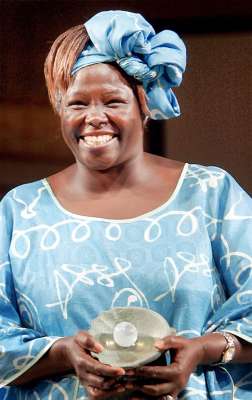 The Norwegian committee charged with awarding the Nobel Peace Prize surprised almost everyone Friday, bypassing the favorites to honor a Kenyan environmental activist. Wangari Maathai is the first African woman to win the Peace Prize, and was clearly elated. The Norwegian committee charged with awarding the Nobel Peace Prize surprised almost everyone Friday, bypassing the favorites to honor a Kenyan environmental activist. Wangari Maathai is the first African woman to win the Peace Prize, and was clearly elated.
"I'm so grateful, I'm so happy!" she exclaimed over the telephone to Norwegian Broadcasting (NRK). "I am absolutely overwhelmed. I did not expect it, this is the biggest surprise of my life."
Maathai, who also works as deputy minister of the environment in Kenya, was cited for her work as leader of the Green Belt Movement, which has planted millions of trees all over Africa.
When asked how planting trees can contribute to peace, she said that trees contribute to the environment and natural resources. "When resources become scarce, we fight over them," she said. "We plant the seeds of peace."
Maathai, who holds a doctorate degree, left a successful academic career to concentrate on her political activities. She said winning the Nobel Peace Prize will only increase her commitment.
"I hope (the prize) will show (to others) that commitment to a common good is worth working for," she said.
The Nobel Peace Prize, which will be formally awarded in Oslo on December 10, the anniversary of Alfred Nobel's death, includes a check for SEK 10 million (USD 1.3 million). Maathai said she initially had no idea what she would do "with so much money."
Record nominations
The committee that chooses the annual winner of the Nobel Peace Prize had a record number of nominations to sort through this year. The committee is appointed by the Norwegian Parliament under the terms of the Alfred Nobel's will.
Nearly 200 candidates were evaluated since nominations closed in March. Known nominees included the European Union, the International Solidarity Movement, Vietnamese human rights activist Dr Nguyen Dan Que and George Ryan, the former Republican governor of Illinois in the US, who gave amnesty to prisoners on death row.
The hottest candidate had been the International Atomic Energy Agency (IAEA), and its leader Mohamed El Baradei. Stein Tønnesson of the International Peace Research Institute (PRIO) in Oslo said earlier this week that he thought it was "about time" that the IAEA and El Baradei were recognized for their work.
The IAEA's main goal is to limit the spread of nuclear weapons, and it played a key role in the hunt for weapons of mass destruction in Iraq. It also is currently active in attempts to control the development of nuclear weapons in both Iran an North Korea.
Via Aftenposten News in English.
|